Upstream (upstream.so) is the best 24/7 live streaming software for most channels. It does four jobs in one plan: 24/7 streams from looping playlists, scheduled prerecorded streams, live shows with guests in a browser studio, and multistreaming to up to 10 of 30+ platforms at once. Every feature is on every plan, the free one too. Most tools in this list are built around one of them: a bare video loop (Runnel.live, StreamHouse, Live247, Gyre), live shows (Restream) or a 24/7 extra for YouTube only (OneStream Live). LiveReacting comes closest, with 5 platforms against Upstream’s 10 and 3 guests against 10 people on stage.
Upstream plays your videos and music from the cloud, so the stream keeps going with your computer off, and on a paid plan it loops with no limit on hours. Music and visuals sit in separate playlists, overlays like the current song update on their own, and you can change any of it while you’re live. When you go live on camera, you do it in the same stream, and your playlists keep the channel live between shows, so one paid stream covers both. One stream costs $30 a month, or $24 a month billed yearly. With 4 or more streams, each one is $20 a month, or $16 billed yearly. The free plan gives you 24 streaming hours every month with no card.
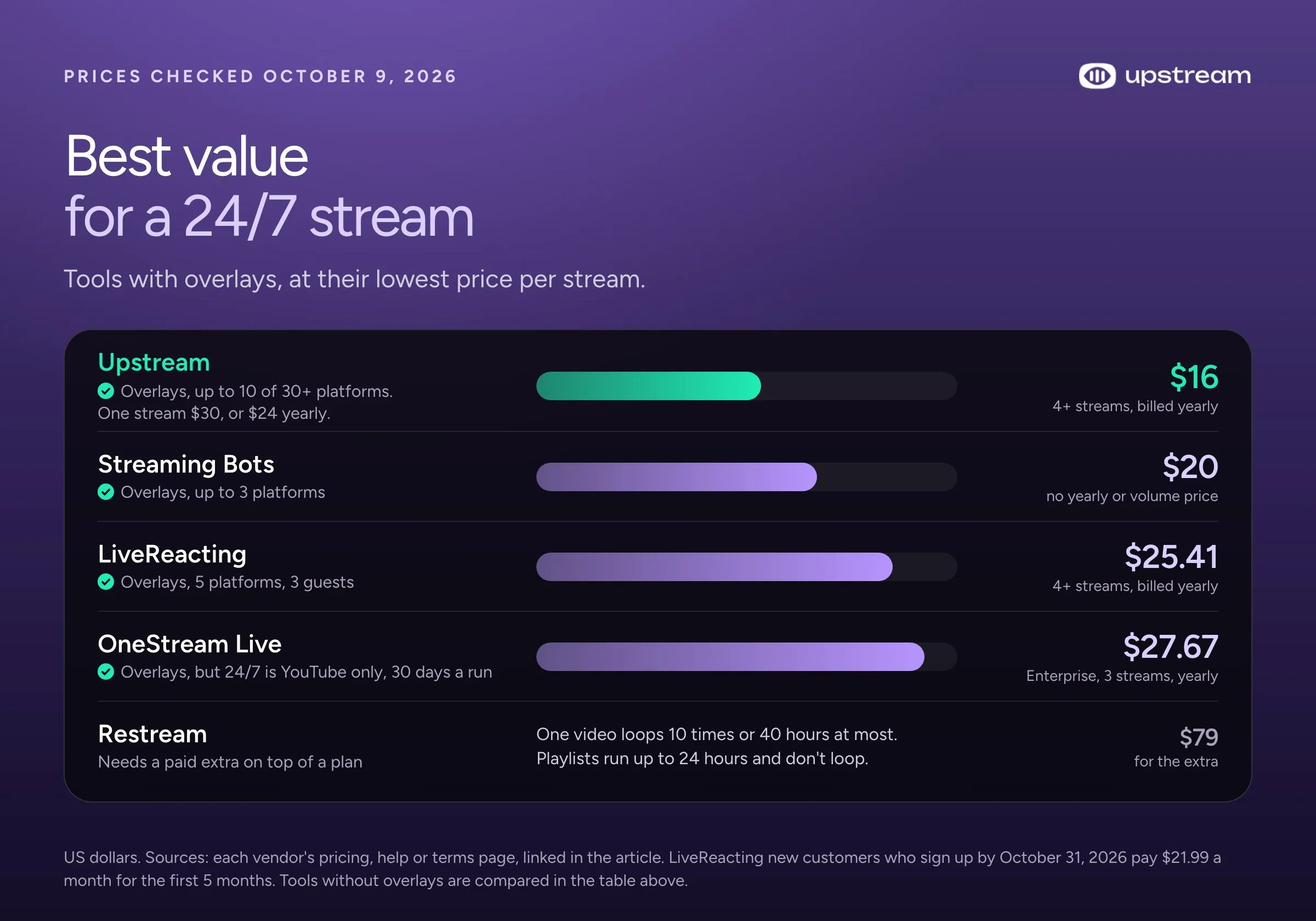
At $16 a stream, Upstream is the cheapest cloud service here with overlays. The services that go lower are bare video loops with no overlays, like Runnel.live ($6 a month plus a one time fee per GB you upload) and StreamHouse ($19, or $15.20 billed yearly). Live247 (about $20) and Gyre list no overlays either. With a bare loop, everything on screen has to be edited into the video file on your own computer before you upload it. OBS is free, but it only streams while your own computer stays on. And Restream’s own help center says an uploaded video loops at most 10 times or 40 hours, which is under two days.
Compare prices and limits
Prices checked October 9, 2026, on each vendor’s own pricing, help or terms page, and each price links to its source. All prices are US dollars a month for one stream at 1080p running all month, billed monthly unless the column says yearly. One stream is one broadcast with its own playlists, so a second channel with different videos needs a second stream.
Overlays are layers on top of the video, like the song title, a logo or a clock, so they don’t have to be part of the video file. “Loops until you stop it” means no limit on loops or hours. A separate audio playlist plays songs from their own list over a looping video or image, so you can change the music without touching the video. Multistream means one stream goes to several platforms at once.
| Tool | One 1080p stream, all month | Billed yearly | Overlays | Free plan or trial | Loops until you stop it | Separate audio playlist | Multistream | Best for |
|---|---|---|---|---|---|---|---|---|
| Upstream | $30, from $16 per stream with 4+ streams yearly | $24 a month | Yes, live layers you can change while streaming | 24 hours free every month, no card | Yes | Yes, plus a second channel for ambience | Up to 10 of 30+ platforms | Best value for 24/7, prerecorded, live and multistreaming in one |
| Runnel.live | $6 plus a one time upload fee per GB | No yearly plan | No | None | Yes | No, video files only | No, one destination per stream | A bare YouTube loop, but no overlays and one platform |
| StreamHouse | $19 | $15.20 a month | No | 24 hours once, card needed | Yes | Not documented | Yes, limit per stream not documented | A cheap video loop, but no overlays |
| Live247 | About $19.94 (2.73 cents an hour) | No yearly plan | None listed | Free to start, no card | Yes | Audio playlists (MP3), music over a video not documented | YouTube only | 4K ambience on YouTube, but no overlays listed and YouTube only |
| Streaming Bots | $20 | No yearly plan | Yes | 24 hour trial | Yes | Yes, in Radio Stream mode | Up to 3 platforms | A simple loop on 3 platforms, but 1080p only |
| LiveReacting (24/7 plan) | $39.99 | $33 a month | Yes | Free plan, no 24/7 | Yes | Yes | 5 destinations | Chat games, but 5 platforms and $39.99 a month |
| Gyre | $99 for playlists (the $49 plan has none) | $82.17 a month | None listed | 7 day trial, turns into $99 a month | Yes, with playlists (from $99 and in the trial) | Not documented | One platform per stream, more platforms use more streams | Many YouTube loops, but no overlays listed and playlists from $99 |
| OneStream Live | $69 to $99 (its pricing page and help center differ) | $83 a month on Enterprise | Yes | Free plan, no 24/7 | Limited: 30 days per run | Not documented | YouTube only in 24/7 mode | Live shows to many platforms, but 24/7 is YouTube only for 30 days |
| Restream | No documented month long loop ($79 Marathon extra loops up to 40 hours) | Not documented | Yes, on playlists | Free plan streams uploads, no loops | No: 10 loops or 40 hours | Not documented | 2 to 8 channels by plan | Live shows, but loops stop at 10 plays or 40 hours |
| OBS on your PC | $0 for the software, plus power | None | Yes, on your PC | Free, open source | Yes, while the PC runs | Yes, as separate sources | Needs a plugin or relay | Full control, but your PC has to stay on |
| Rented server (VPS) with FFmpeg | About $12 | None | With scripting and a bigger server | Promo credit for new users on some hosts | Yes | With scripting | With scripting | Linux users, but no interface and you script everything |
Why tools without overlays don’t compare
A 24/7 channel usually shows the song title, a now playing bar, your logo, a clock or a subscribe prompt on top of the video. A tool without overlays can only play the file you give it, so all of that has to be baked into the video itself. You edit and render the video on your own computer, then upload hours of it. Every change starts that over. A new track, a typo in a song title or a new logo means another render and another upload, and on a music channel the title on screen has to match every song.
Runnel.live and StreamHouse have no overlays, and Live247 and Gyre list none, so that work stays on your computer. Their prices pay for a server that plays a finished file on repeat.
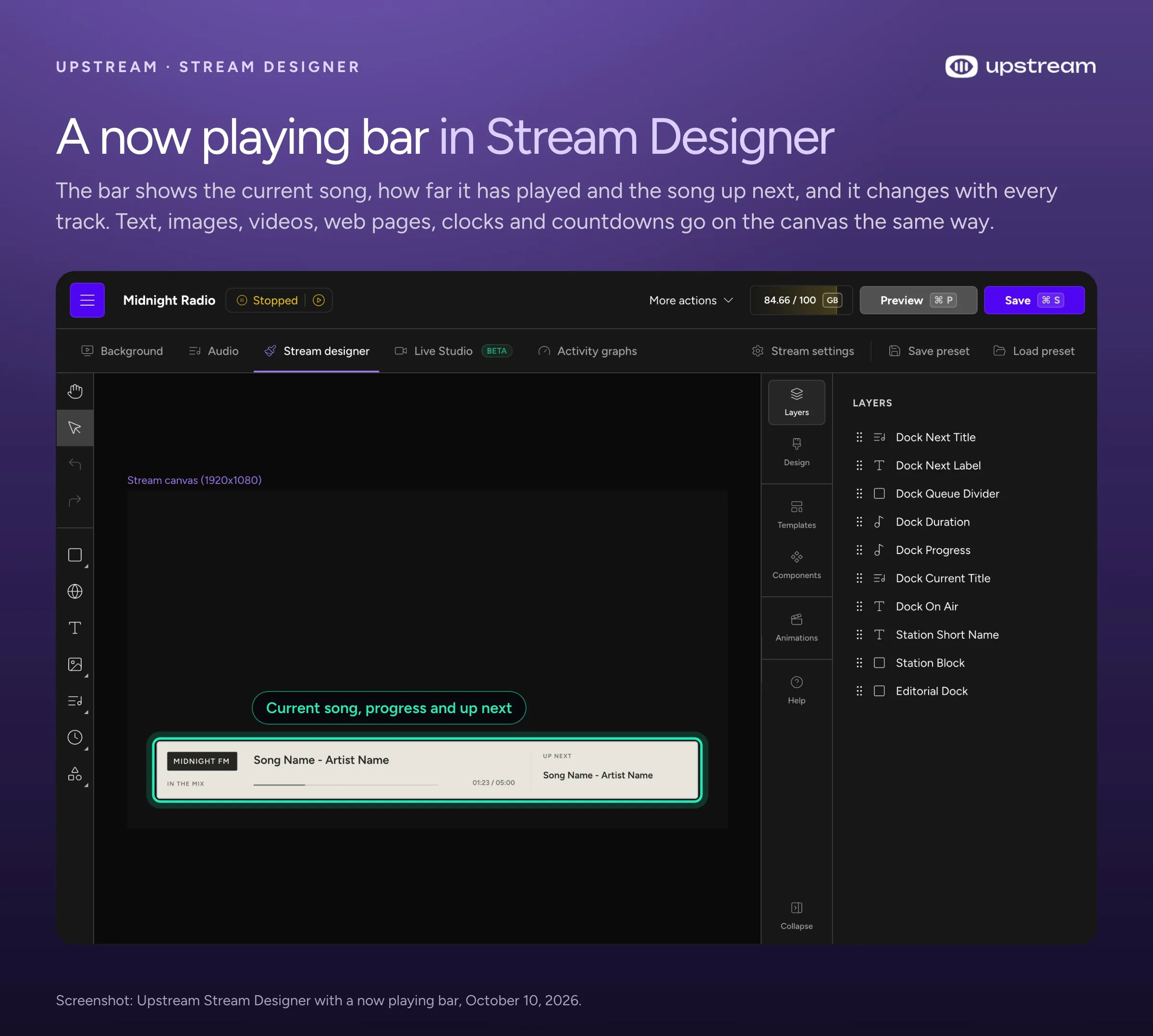
On Upstream, overlays are live layers on the stream. You place text, images, a clock, web widgets and a current song box in Stream Designer. The current song box reads each song’s title, artist and cover from the file’s tags in your audio playlist and changes on its own when the next song starts. Music and video run in separate playlists, so a new track is one audio upload, with no new video. You can change a title, swap the logo or add songs while the stream keeps running. When you go live on camera, your live video is one more layer on the same stream.
Turn recordings into live streams.
Upload videos, schedule them as live events, or keep a channel running up to 24/7 without staying on camera or leaving a computer online.
What a 24/7 streaming tool has to do
We run 24/7 YouTube streams on Upstream every day. Seven things decide whether a channel like that stays up and keeps its viewers.
- It runs without your computer. If the stream comes from your PC, a Windows update, a power cut or a router restart ends it. A cloud service plays the files from its own servers.
- It loops with no limit. Some tools stop after a set number of loops or hours. Check the cap before you plan a month.
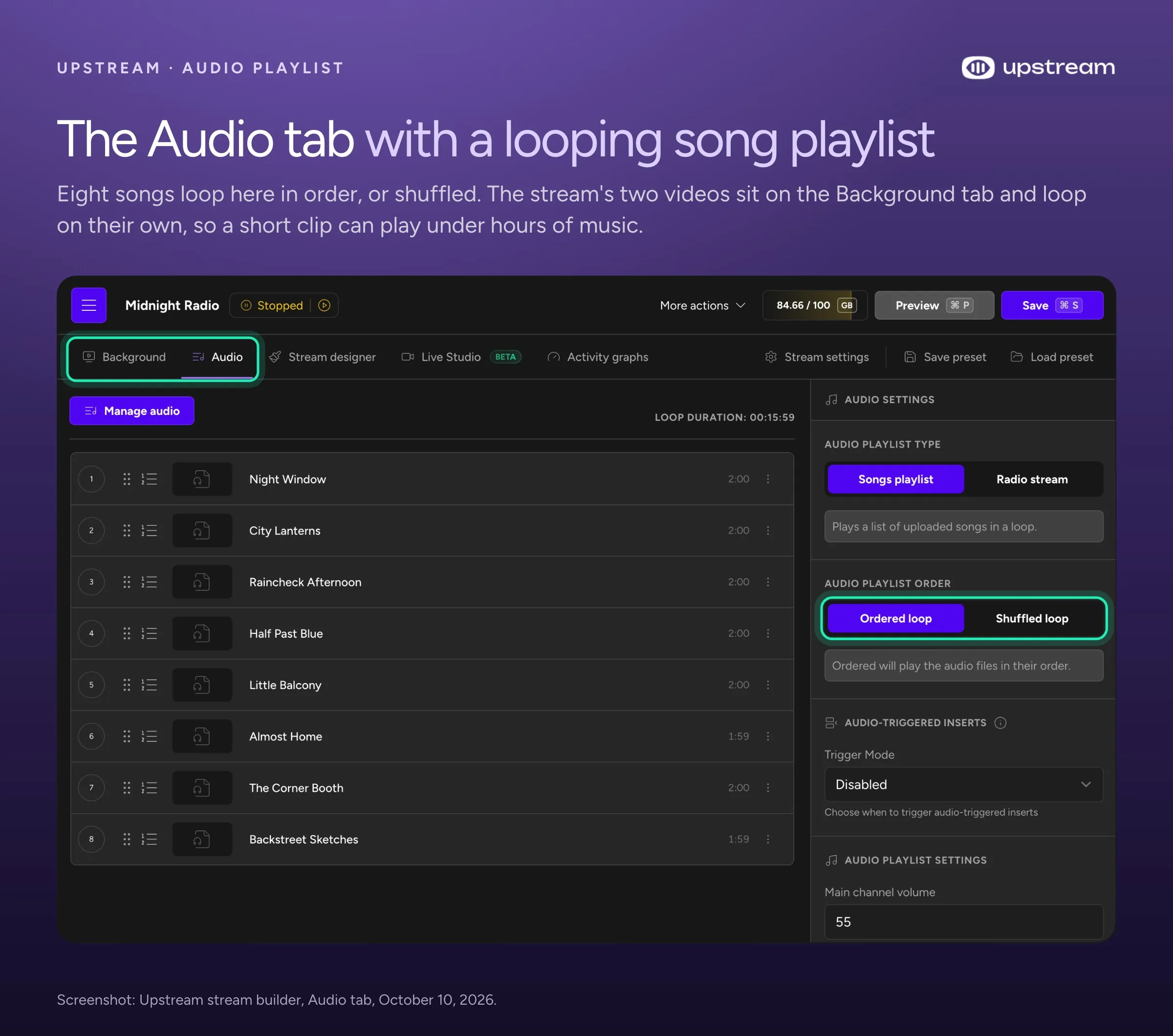
- Music and visuals run separately. A lofi or radio channel plays hours of songs over a short clip. With two playlists that each loop on their own, adding a song doesn’t mean rendering a new long video.
- You can change it while it’s live. Adding a video or swapping an overlay shouldn’t end the stream.
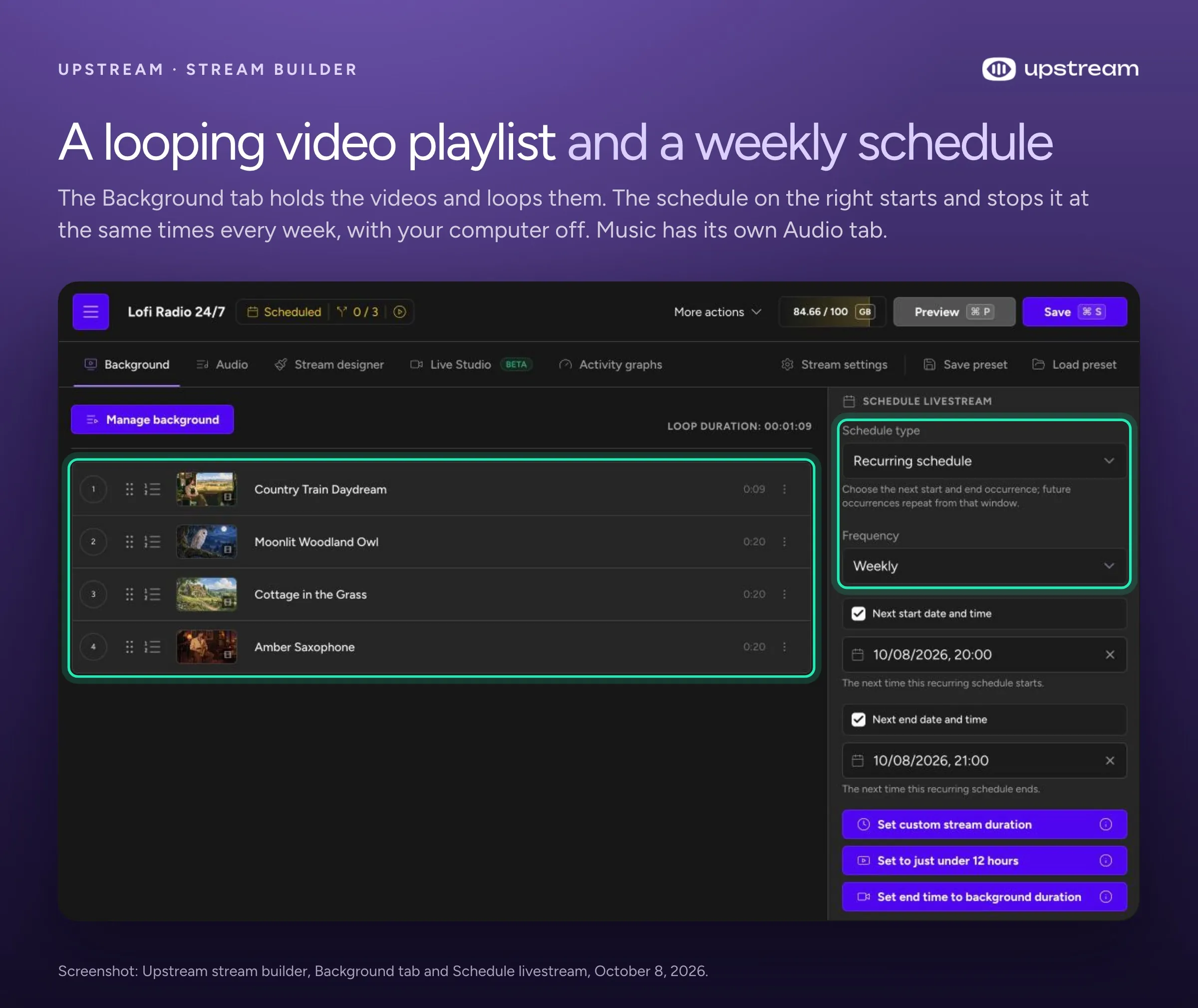
- It schedules. Start and stop times, repeats every day or week, and breaks when you want them. Even a channel that never stops uses this, to run in cycles or to air a sermon at the same hour every Sunday.
- It reaches the platforms you care about. One stream to YouTube, Twitch and Kick at once, without sending a copy to each from your own connection.
- The price covers a full month. A stream that never stops runs about 730 hours a month, so hourly prices and hour caps add up. A free plan lets you test with your own files first.
Three platform rules apply whichever tool you pick. YouTube publishes no maximum length for a live stream, but it only keeps a replay automatically (the saved video of the stream) when the stream is under 12 hours, so a stream that runs for days may leave no video on your channel. Twitch ends a broadcast at 48 hours. Facebook and Instagram cap lives at 8 and 4 hours, so a 24/7 channel belongs on YouTube, Twitch or Kick. Our post on whether YouTube allows 24/7 streams and our page on platform limits have the details.
Upstream: best value for 24/7, prerecorded, live and multistreaming in one
Upstream (upstream.so) does four things in one plan that most tools here split up or leave out. Those are 24/7 streams of prerecorded videos and music from looping playlists, scheduled prerecorded streams, live shows with guests in Live Studio, and multistreaming to up to 10 of 30+ platforms at once. It runs from the cloud with your computer off, every feature is on every plan including the free one, and YouTube lists Upstream among its verified encoders for YouTube Live.
LiveReacting comes closest, and Upstream does more with fewer limits. One stream goes to 10 platforms against LiveReacting’s 5, and 10 people fit on stage against its 3 guests. The free plan streams 24 hours every month against three 30 minute streams, and Upstream costs from $16 a stream against LiveReacting’s $25.41.
Paid plans cost $30 a month for one 1080p stream with no hour limit, or $24 a month billed yearly. With 4 or more streams, each one is $16 a month billed yearly. The free plan streams 24 hours every month with no card. You upload your files, build the stream in your browser and press start.
Music and visuals in separate playlists
In Upstream, a 20 second clip can loop under four hours of songs. The video playlist (Upstream calls it the background) and the audio playlist each loop on their own, in order or shuffled. Upstream mixes them live, so adding a song takes one upload and you never render a long video again. A second audio channel can loop rain or a fireplace under the music. The page on separate audio and video playlists shows how it works.
Change it while it’s live
Add, remove or reorder songs and videos, and change overlays, while the stream runs. Click Publish changes and the stream picks them up without stopping. Skipping a track or playing any file right now goes on air at once. Turning on an extra platform while you’re live makes every platform reconnect for a moment, so add your platforms before you start.
Schedules that start on their own
Schedule a stream once, repeat it every day or every week, or run it in back to back cycles with a break in between. A scheduled stream starts on its own with your computer off, which is how a church service or a weekly show airs at the same hour every week. Ending each cycle just under 12 hours lets YouTube archive each part as its own replay. With YouTube Connect, Upstream creates the YouTube broadcast with your title, description and thumbnail.
Overlays, stings and ads
Stream Designer puts text, images, videos, web pages and widgets (StreamElements alerts, for example), a clock or countdown, and boxes that show the current song and video on top of your playlists. The current song box can show each song’s title, artist and cover from the file’s own tags, and it changes with every song. Stings, jingles and ad inserts, short clips like a channel intro or a sponsor message, can play after every few videos or every few minutes. On a monetized YouTube channel connected with YouTube Connect, Upstream places YouTube’s midroll ads in the gap between two videos.
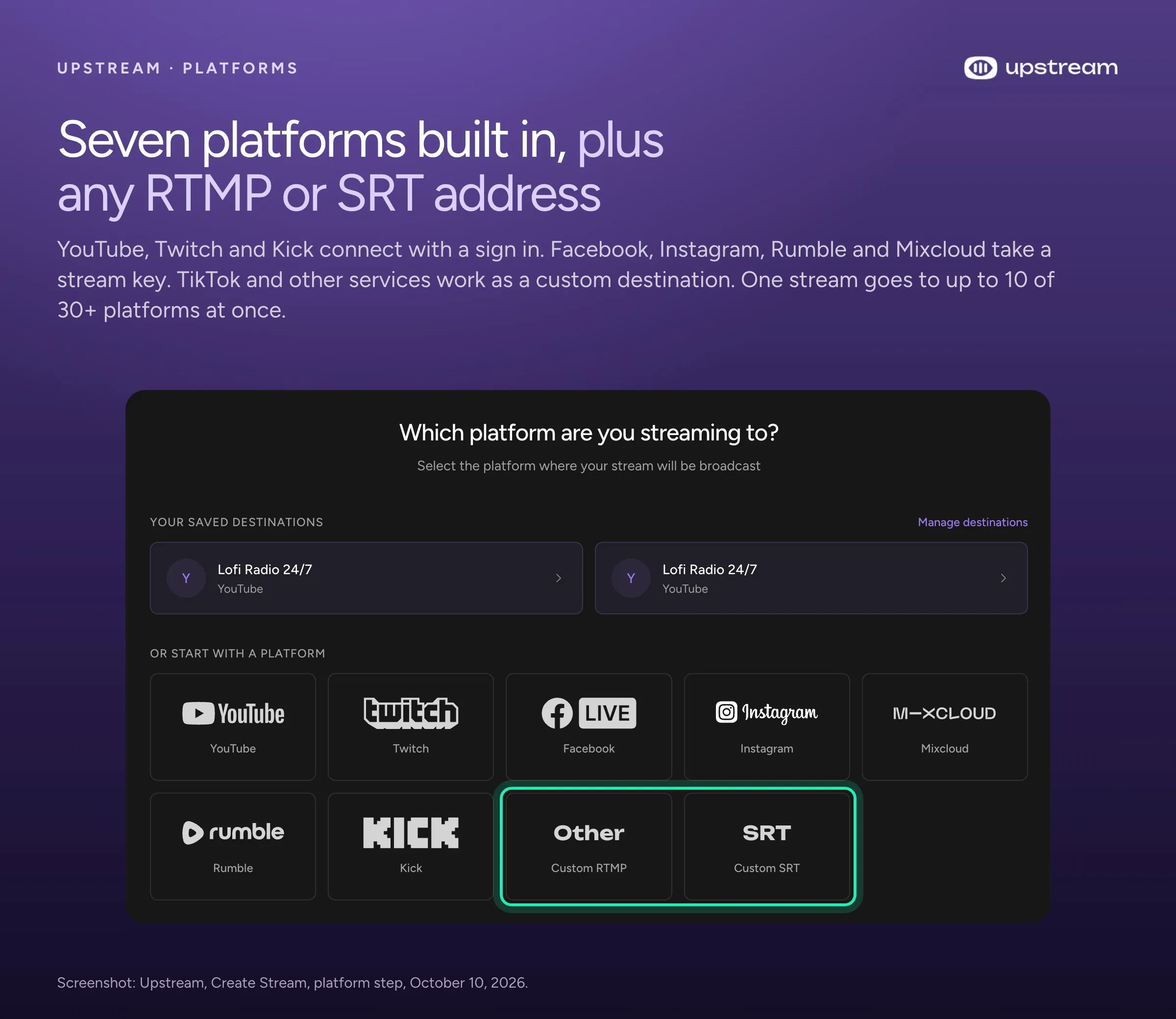
Up to 10 of 30+ platforms at once
One stream goes to up to 10 of 30+ platforms at once, on every plan including free. YouTube, Twitch and Kick connect with a sign in. Facebook, Instagram, Rumble and Mixcloud take a stream key, the code a platform gives you to go live. TikTok, or any other service that gives you an RTMP or SRT address, works as a custom destination. Twitch ends a broadcast at 48 hours, and Upstream reconnects on its own, so viewers see a short break and the stream carries on.
Live shows and the 24/7 loop in one paid stream
One paid stream does both jobs. When you’re live, on camera in Live Studio or from OBS, your show is what viewers see. When you’re not, the same stream plays your prerecorded playlists around the clock, so the channel stays live between shows and you still pay for one stream. With a bare loop tool you’d pay for a separate live tool as well.
Live Studio runs in your browser. Guests join by link with no account, and up to 10 people can be on stage. Their live video goes on top of the running 24/7 stream, full screen or in a corner, for a sermon, a Q and A or a premiere. The playlist keeps playing underneath, and when you leave the stage it takes over again. If your OBS feed drops, the stream falls back to your prerecorded content until you reconnect.
Price: $30 a month, from $16 a stream
One 1080p stream at 30 fps costs $30 a month, or $24 a month billed yearly, with no hour limit. Two streams are $50 a month and three are $70. With 4 or more streams, each stream is $20 a month, or $16 billed yearly. One stream at 1080p and 60 fps is $40 a month, and 4K at 30 fps is $70. Every 1080p plan, free included, comes with 100 GB of storage per stream. The free plan gives you one stream with 24 streaming hours every month (it resets monthly) at 1080p and 30 fps, with every feature, no card and no watermark. That’s about a day out of a 730 hour month, enough to test your channel before you pay. See pricing.
Each tool below stops at something Upstream includes, from overlays and more platforms to loops with no cap. With Upstream, your 24/7 channel, your scheduled streams and your live shows run in one place, and you can change any of it without stopping the stream.
Runnel.live: best for a bare YouTube loop, but no overlays and one platform
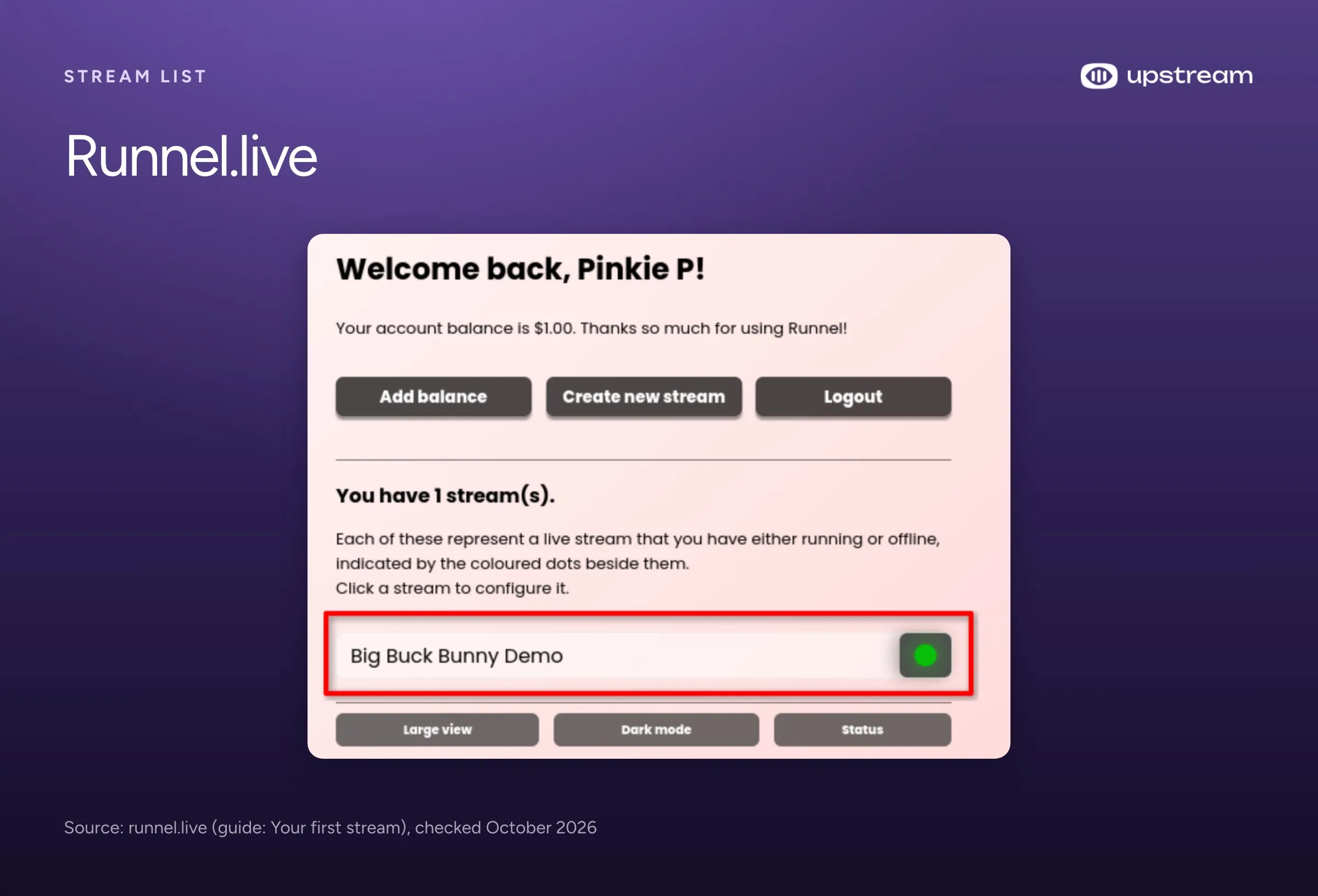
Where it stops: no overlays, video files only and one destination per stream. Everything on screen has to be rendered into the video on your own computer, and with no audio playlist a new song means a new video.
Runnel.live is built for YouTube. It says Twitch and Rumble are only partly supported (streams may reconnect between videos), and there’s no free plan or trial. It costs $6 a month per stream, taken by the minute from prepaid credit, plus a one time upload fee per GB ($0.07 a GB for HD video). That price pays for a server that plays your finished files on repeat, at the same rate up to 4K at 60 fps. It has a video queue with shuffle and scheduled starts, and you can upload more videos while it runs. Its terms say all sales are final, and its help page offers a refund only when most of the credit is unused. See Upstream vs Runnel.live.
StreamHouse: best for a cheap video loop, but no overlays
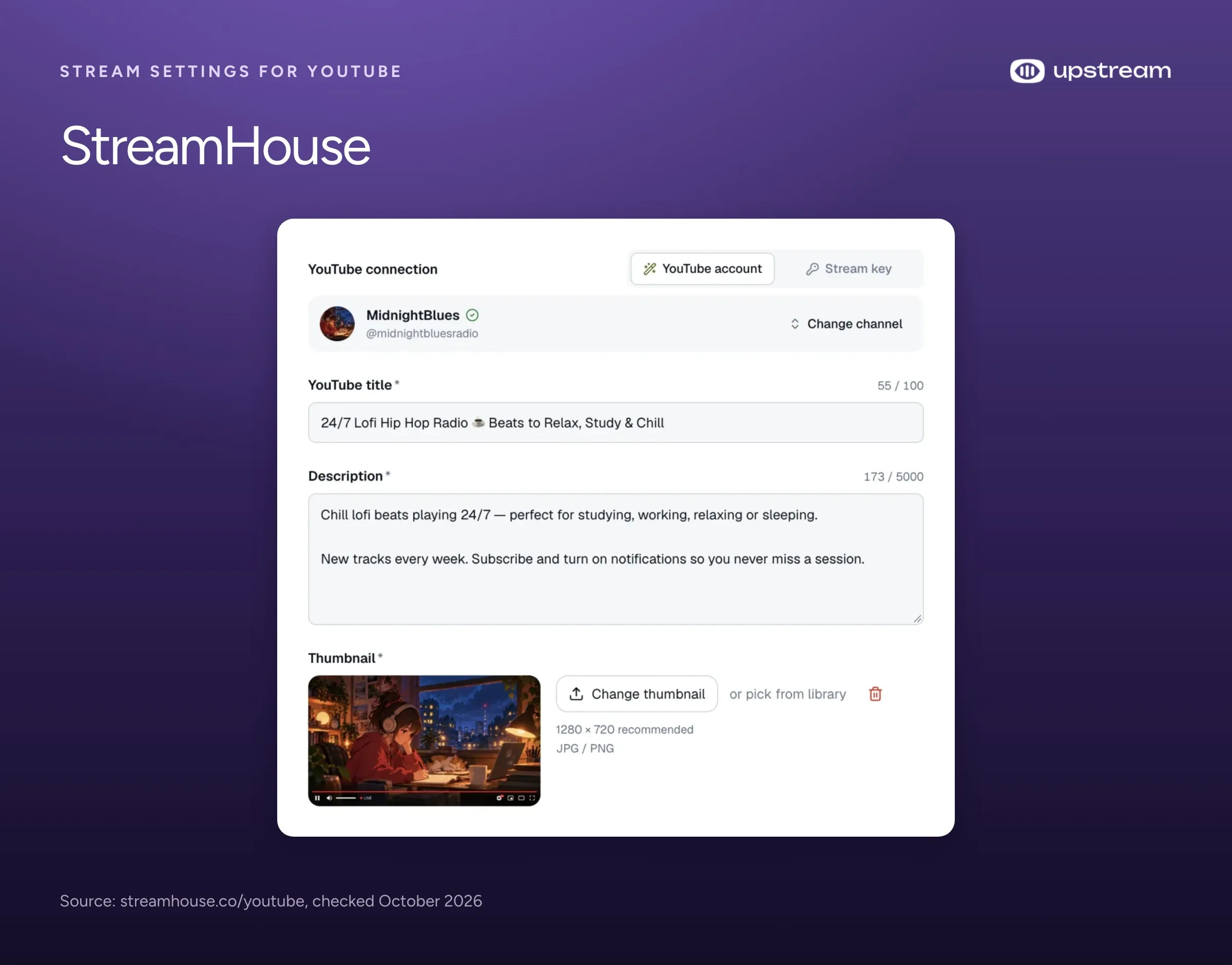
Where it stops: no overlays and no browser studio, so the song title, your logo and anything else on screen has to be rendered into each video before you upload it. Its pages don’t mention an audio playlist. The free allowance is 24 hours of streaming once, and it needs a card.
StreamHouse (streamhouse.co) charges $19 a month for that bare loop: one stream at 1080p and 30 fps with 150 GB of storage, or $15.20 a month billed yearly. 4K at 30 fps is $49. Playlists start again from the top and run with no hour cap, and you can add, remove or reorder videos while it’s live (the current video finishes first). One broadcast can go to several platforms, and StreamHouse doesn’t say how many at once.
Live247: best for 4K ambience on YouTube, but no overlays listed and YouTube only
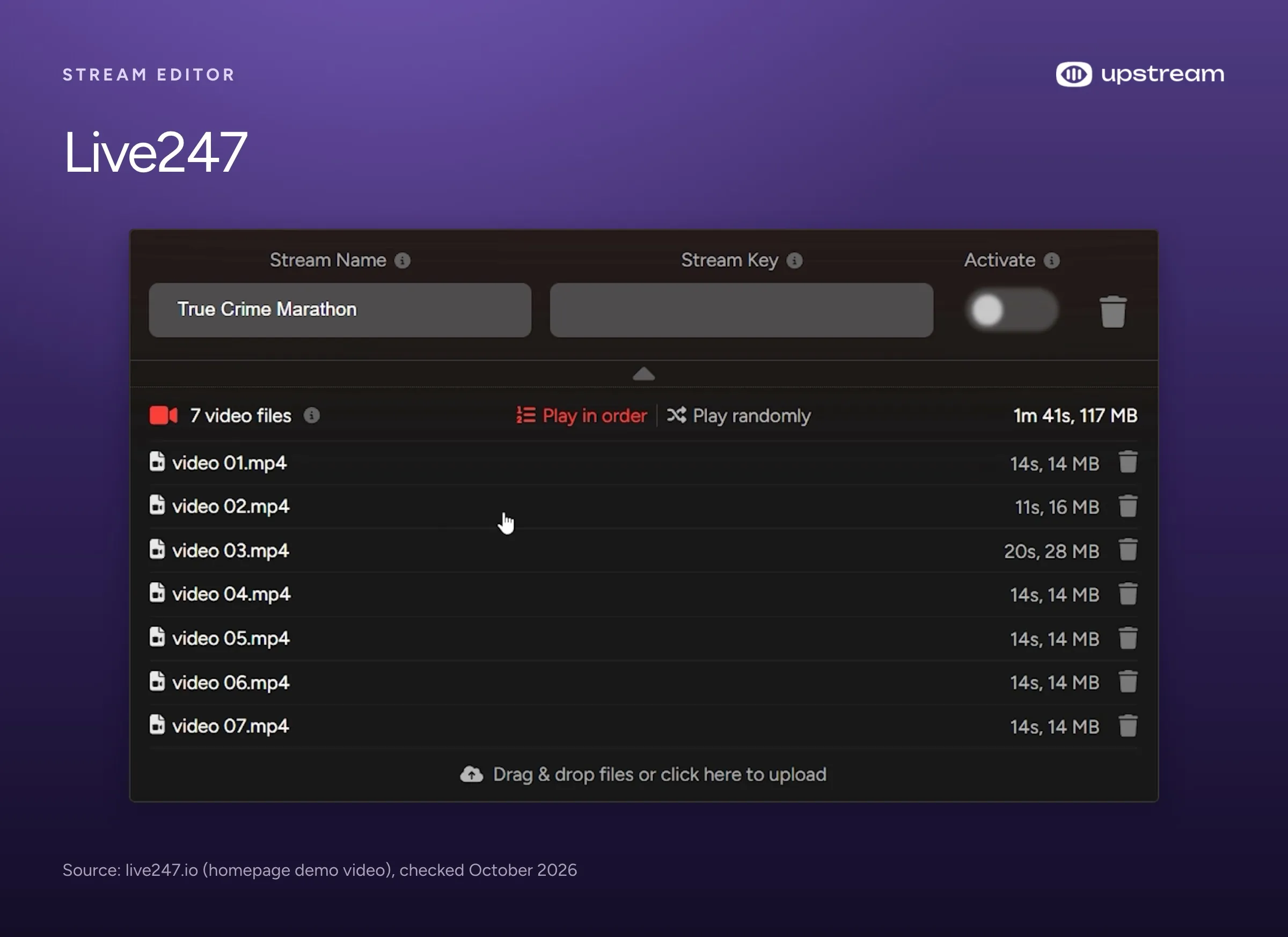
Where it stops: it streams to YouTube only and lists no overlays, so anything on screen has to be rendered into your MP4 files first. Its pages don’t say it can play songs over a separate looping video. You pay from prepaid credit, and its terms say all sales are final.
Live247 (live247.io) charges 2.73 cents an hour per stream at 1080p and below for that bare loop, about $19.94 for a full month. 1440p and up costs 5.46 cents an hour (about $39.88 a month). It loops a playlist of MP4 videos or MP3 songs, handles 4K at 60 fps and 10 bit HDR, and lets you replace files while the stream runs. You can start for free without a card. See Upstream vs Live247.
Streaming Bots: best for a simple loop on 3 platforms, but 1080p only
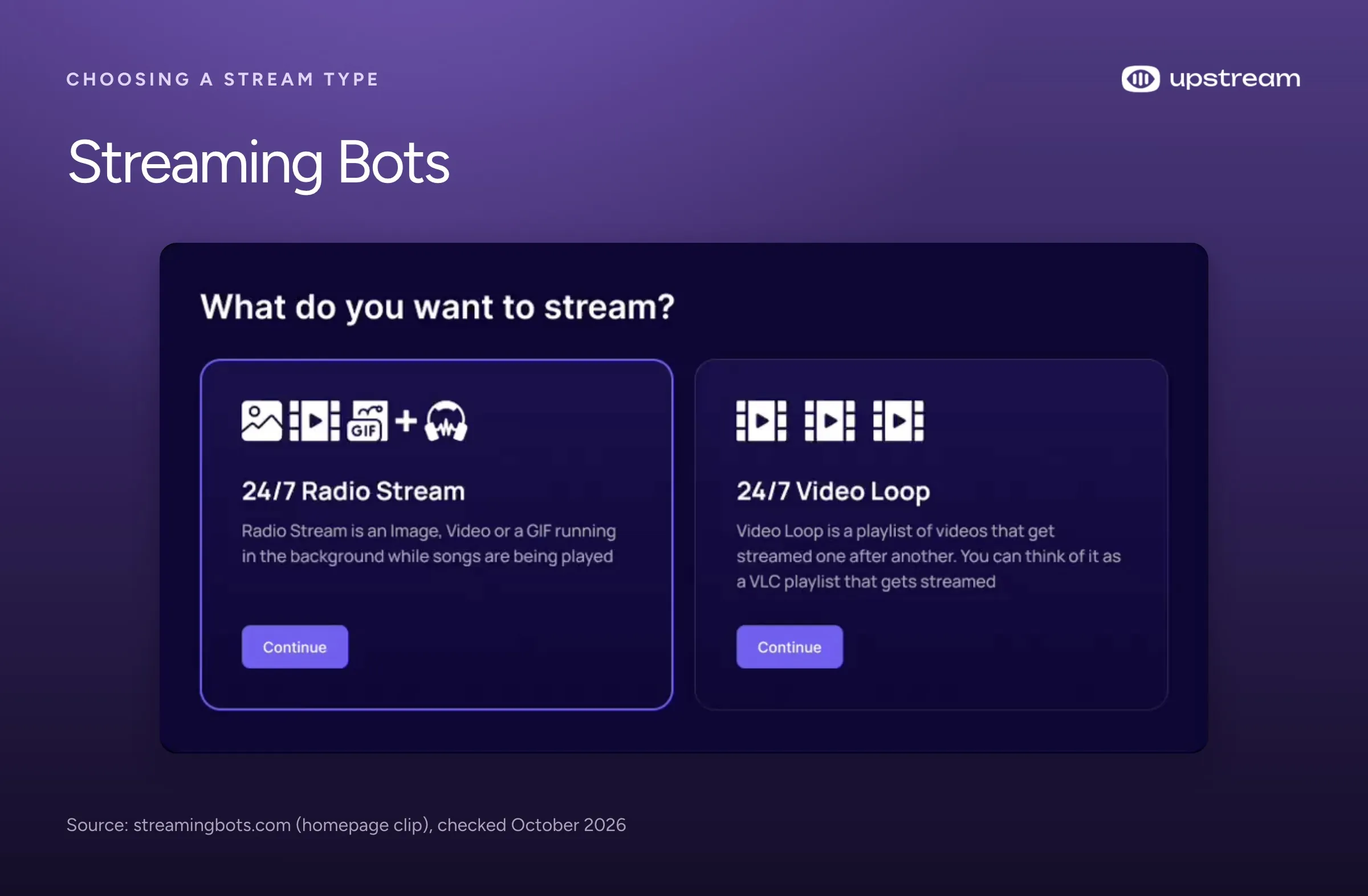
Where it stops: 3 platforms per stream, 1080p at 30 fps and 65 GB of storage, with no yearly plan, and its page doesn’t mention live guests.
Streaming Bots (streamingbots.com) costs $20 a month per stream, shown as a discount from $30 with no end date, with a 24 hour free trial and a 7 day money back guarantee. It has a Video Loop mode and a Radio Stream mode (songs over an image, video or GIF), with overlays and schedules. For one stream, Upstream costs $10 more. For that it sends the stream to up to 10 of 30+ platforms, goes up to 4K on paid plans, gives 100 GB per stream and adds live guests in Live Studio. Its free plan streams 24 hours every month. From 4 streams Upstream costs less: $16 a stream billed yearly against a flat $20. See Upstream vs Streaming Bots.
LiveReacting: best for chat games, but 5 platforms and $39.99 a month
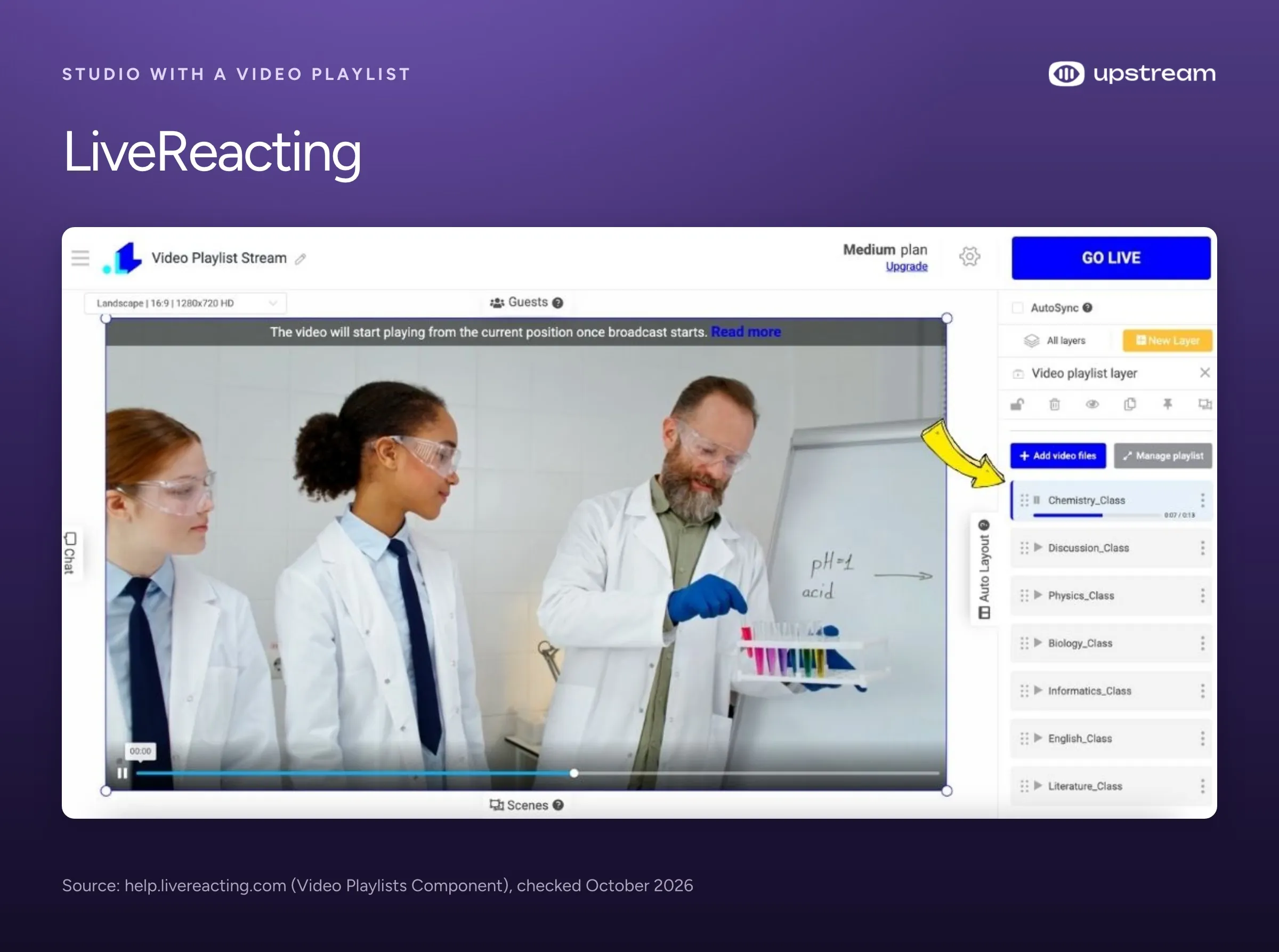
Where it stops: its 24/7 plan sends to 5 destinations with 3 guests for $39.99 a month ($33 a month billed yearly). 60 fps and 4K are on request and cost 1.5 to 3 times as much. The free plan allows three 30 minute streams a month at 720p with a watermark, so it can’t run 24/7.
LiveReacting (livereacting.com) is a browser studio with a 24/7 plan at 1080p and 30 fps. New customers who sign up by October 31, 2026 pay $21.99 a month for the first 5 months with the code KICKSTART2026. It has more chat games than Upstream, like polls, trivia and giveaways. Upstream has fewer limits: one stream to up to 10 of 30+ platforms, up to 10 people on stage, and 24 free hours every month at 1080p with no watermark. After the promo, one stream costs $30 on Upstream and $39.99 on LiveReacting. With 4 or more streams, Upstream is $16 a stream and LiveReacting’s lowest is $25.41. See Upstream vs LiveReacting.
Gyre: best for many YouTube loops, but no overlays listed and playlists from $99
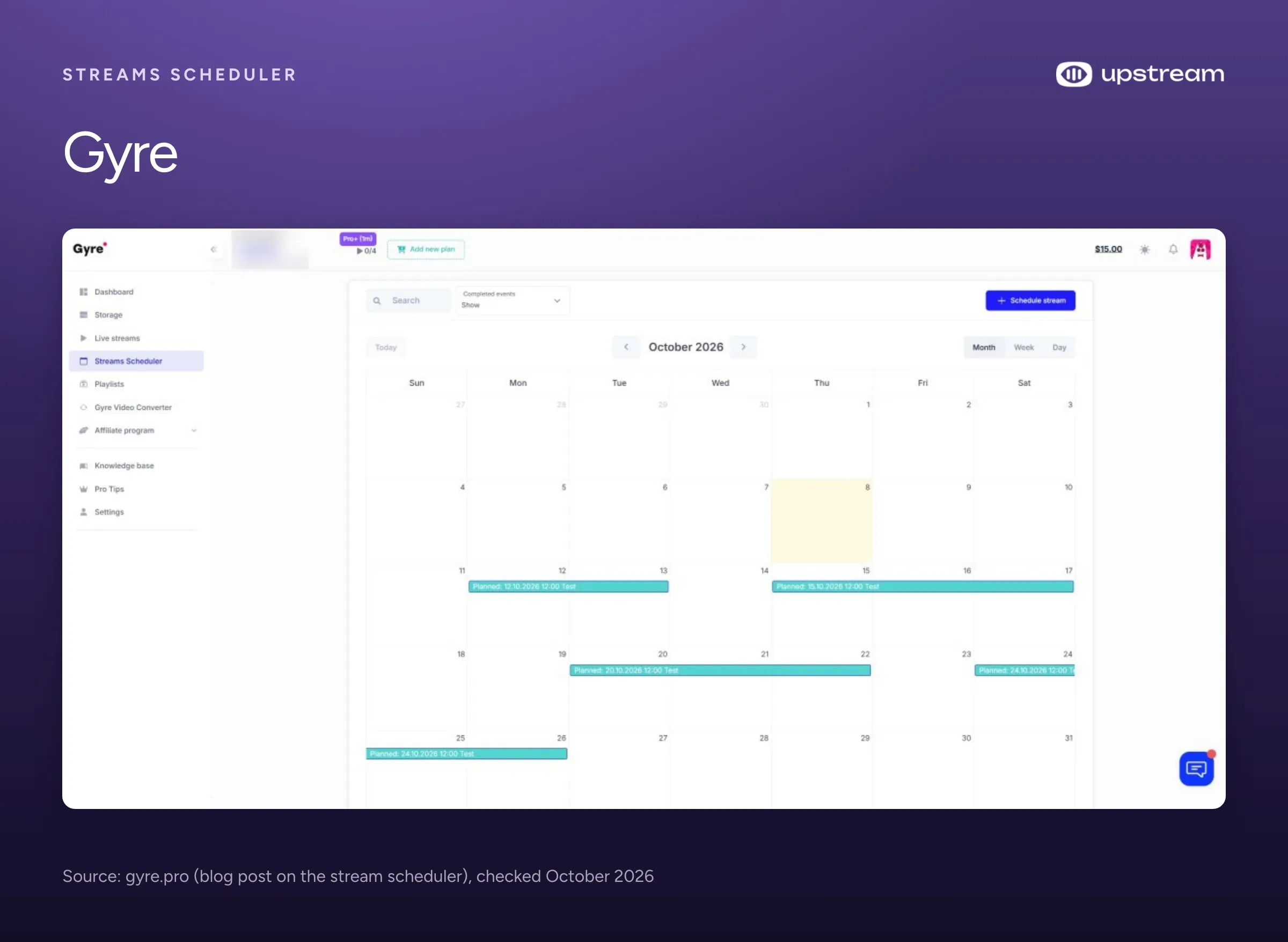
Where it stops: overlays and a separate audio playlist aren’t in its documentation, so the picture has to be finished in the video file before you upload it. Playlists and the scheduler start at $99 a month. The $49 Start plan has neither, and Gyre doesn’t say how it loops without them. Each platform runs as its own stream with its own playlist, so reaching two platforms at once uses two of your plan’s streams. The 7 day trial asks for a payment method and becomes the $99 plan unless you cancel.
Gyre (gyre.pro) runs 24/7 streams of uploaded videos from the cloud. Start+ at $99 a month ($82.17 a month billed yearly) runs 4 Full HD streams or one 4K stream, and PRO+ runs 8 Full HD streams for $169. It streams to YouTube, Twitch, Facebook, Instagram, X, Kick and Mixcloud. On Upstream, playlists and schedules come with the $30 plan and the free one, and one stream reaches up to 10 platforms at once. See Upstream vs Gyre.
OneStream Live: best for live shows to many platforms, but 24/7 is YouTube only for 30 days
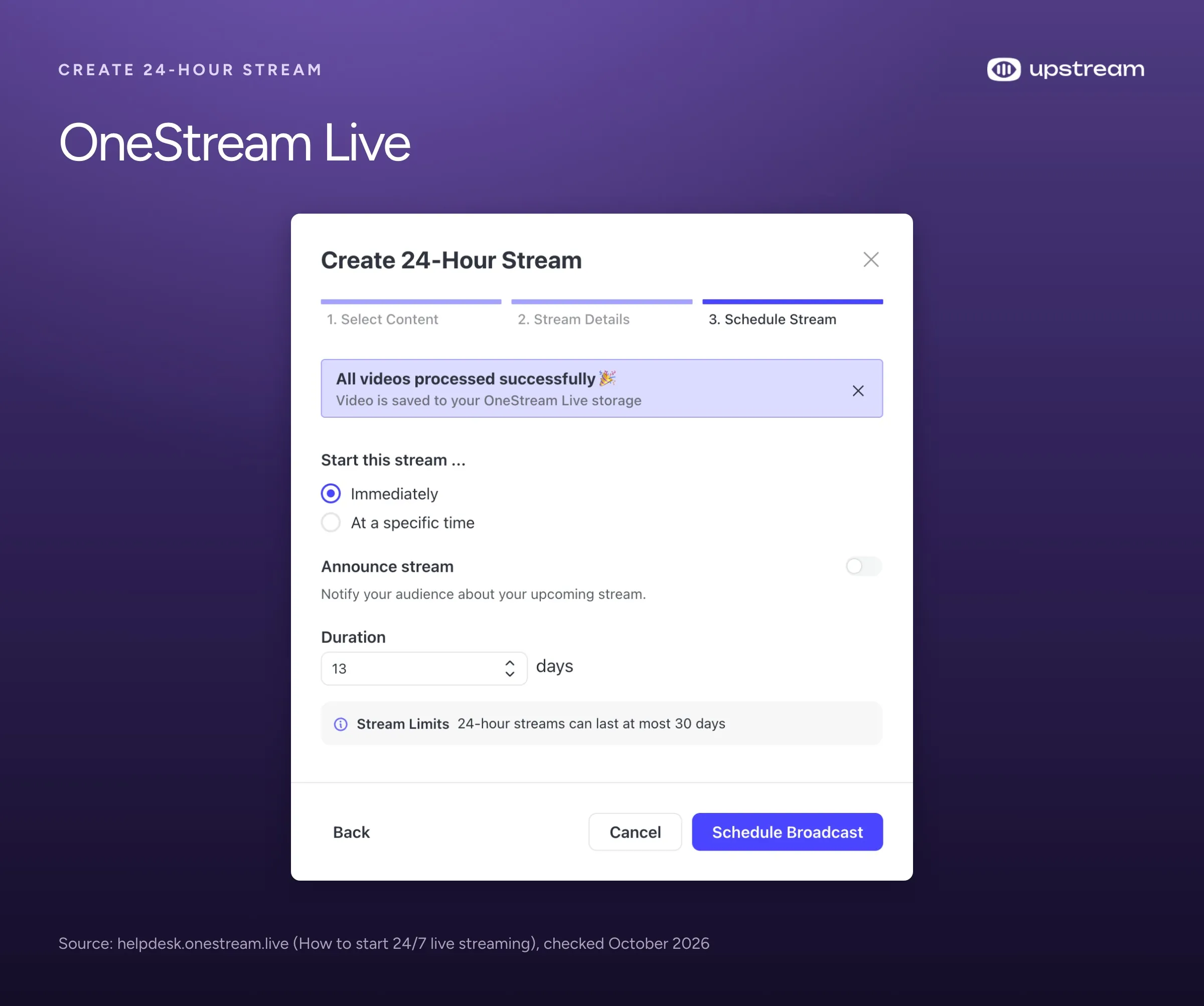
Where it stops: a 24/7 stream goes to YouTube only and runs for up to 30 days, then you start it again. It costs extra, and OneStream’s own pages disagree on how much.
One 1080p 24/7 stream on OneStream Live (onestream.live) costs $69 to $99 a month. Its pricing page sells 24 hour streaming as a $30 a month extra per stream on top of a paid plan (1080p starts on Standard at $39) and lists playlist streaming on Professional ($49) and Enterprise only. Its help center says 24/7 needs the Enterprise plan, which the pricing page lists at $99 a month with three 24/7 streams. A separate audio playlist isn’t documented. Its regular live streams reach more destinations (30 on Professional, 50 on Enterprise), and its 24/7 mode reaches one. Upstream sends a 24/7 stream to up to 10 of 30+ platforms on every plan. See Upstream vs OneStream.
Restream: best for live shows, but loops stop at 10 plays or 40 hours
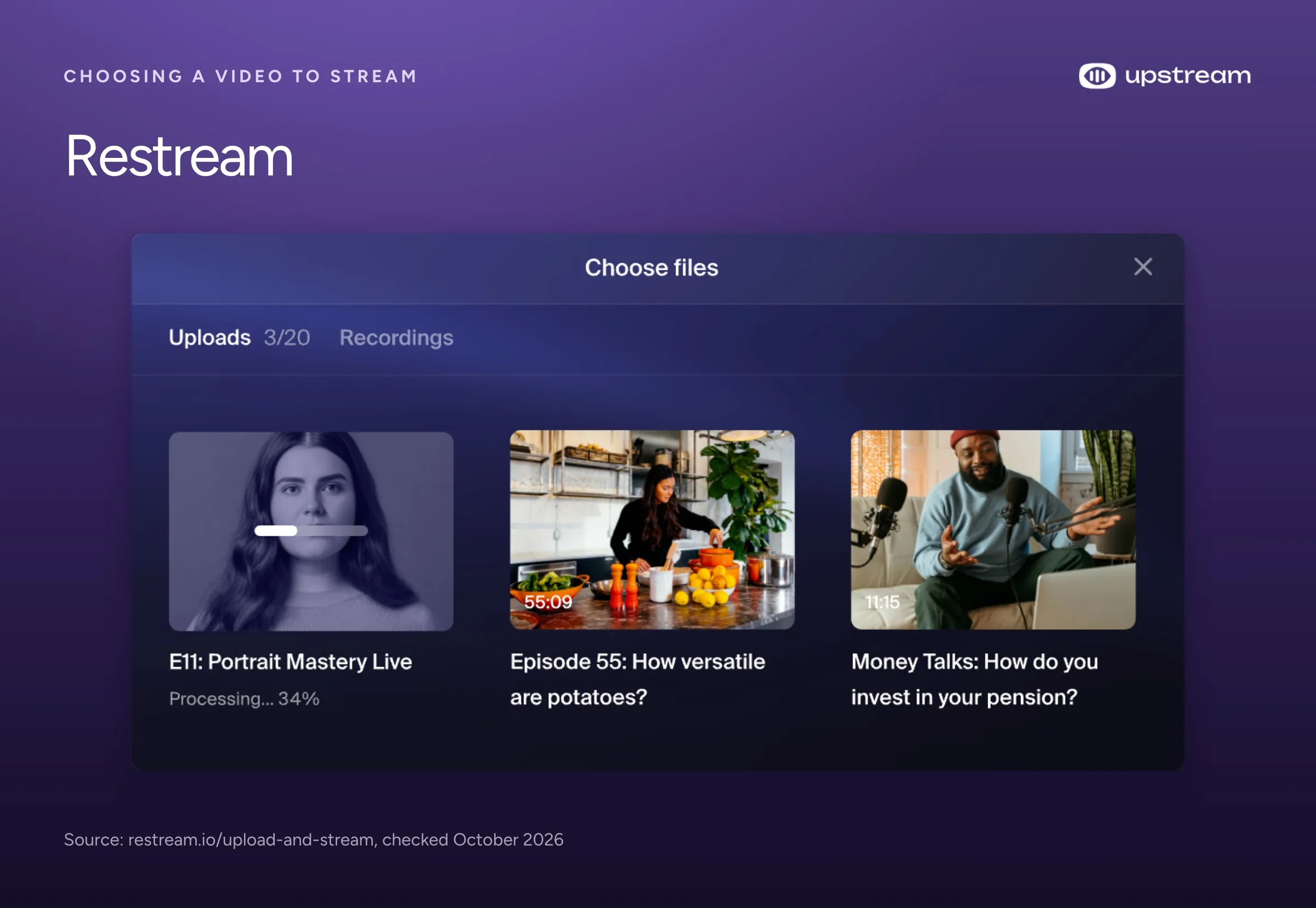
Where it stops: by Restream’s own help center, one video loops at most 10 times or 40 hours, and a playlist runs up to 24 hours (40 videos) and doesn’t loop. Even that needs a paid extra on top of a plan: Marathon at $79 a month (1080p, 4 hours of video library) or Media at $239 (4K, 12 hours). While a playlist airs you can change graphics and chat but not the videos.
Restream (restream.io) is a live multistreaming service with a browser studio and one chat across platforms, and every plan can stream an uploaded video. A 24/7 channel needs a loop that doesn’t stop, which Upstream runs on its $30 plan with no hour limit and no extra to buy. See Upstream vs Restream.
Do it yourself: OBS or a rented server with FFmpeg
OBS on your own PC: best for full control, but your PC has to stay on
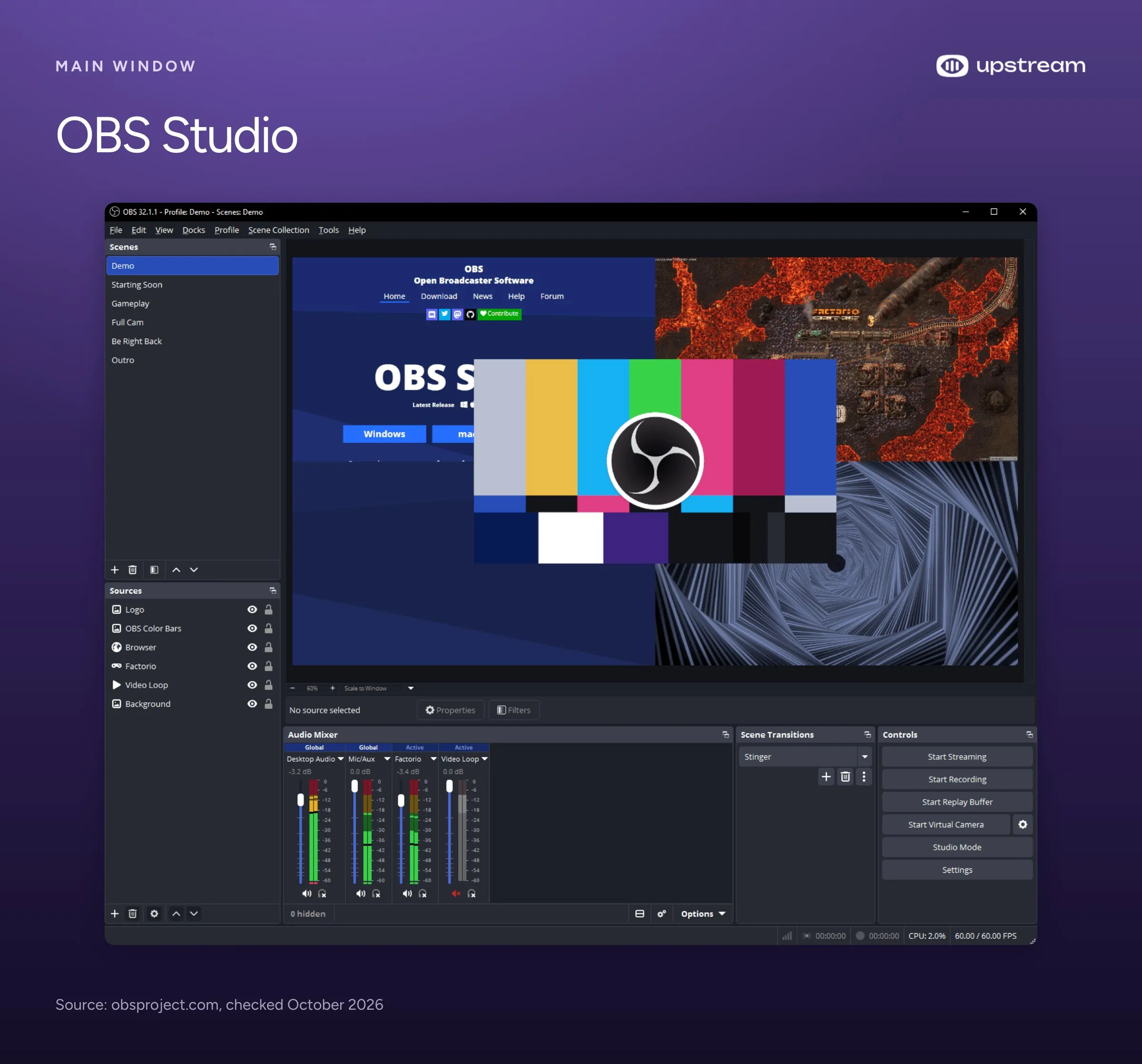
Where it stops: your PC does the streaming, so it has to stay on, awake and online all month. A Windows update, a power cut or an internet drop ends the stream until you start it again.
OBS Studio is free and open source. Add your videos to a Media Source with looping on, or to a VLC playlist, put music on its own source, add overlays and stream. Leaving a PC on all month uses about 44 to 73 kWh of electricity (our estimate for a PC drawing 60 to 100 watts), so multiply that by your price per kWh. Sending to more than one platform needs a plugin or a relay service, and with a plugin each extra platform is another full upload from your home connection. If you already go live from OBS, you can send it into an Upstream stream instead: your show airs while OBS is on, and the playlists take over when you stop.
A rented server with FFmpeg: best for Linux users, but no interface and you script everything
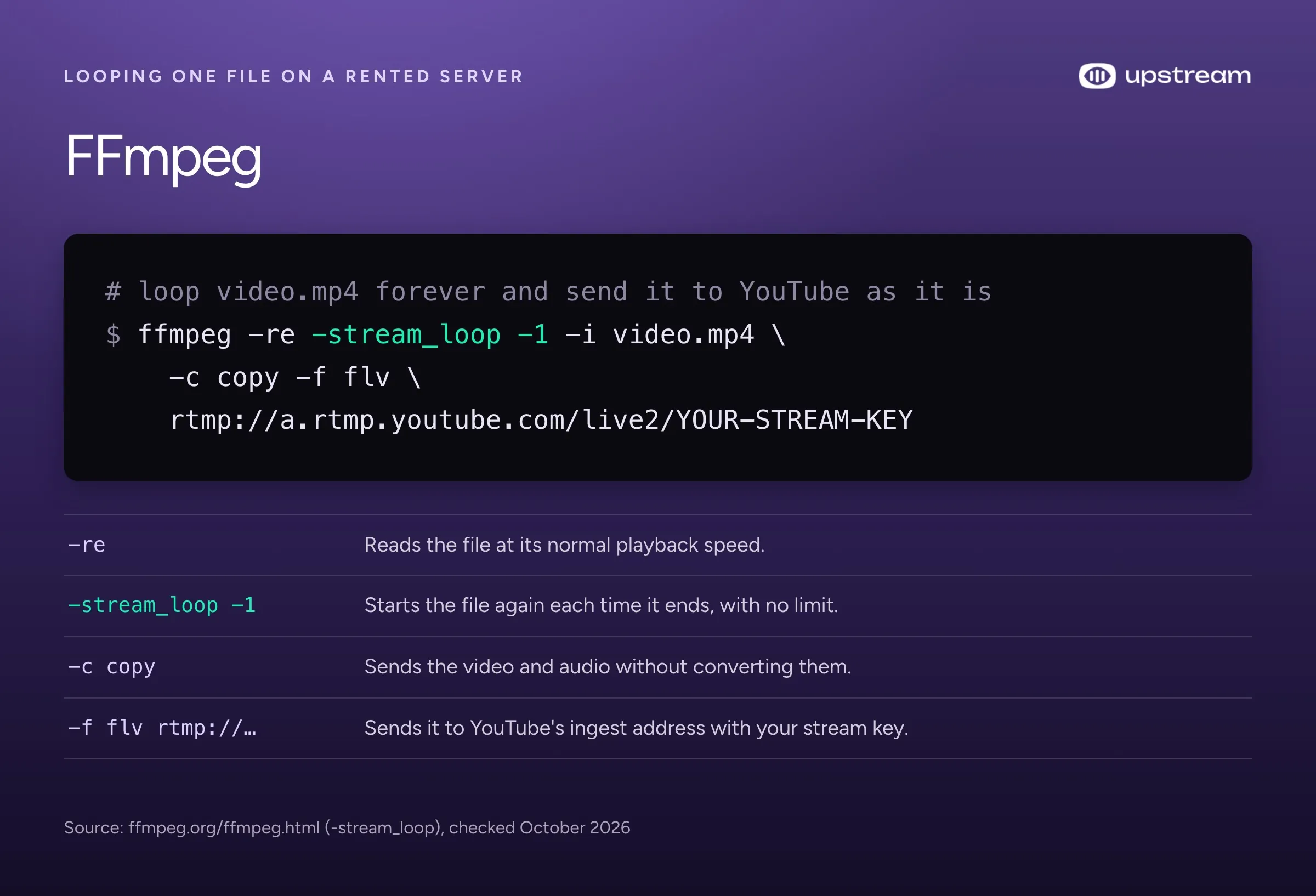
Where it stops: there’s no interface. You write the commands and look after the server, the scripts and every restart. Overlays or a separate music playlist mean converting the video live, which needs a bigger server.
Rent a Linux server (a VPS) and loop the file with FFmpeg, a free command line program that can send a video to YouTube. Its -stream_loop -1 option repeats the file forever. On DigitalOcean, a $12 a month server (1 CPU, 2 GiB of memory, 2,000 GiB of transfer) is enough when the file is already prepared for streaming, so the server only sends it and doesn’t convert it. A 1080p stream at 4.5 to 6 Mbps uses about 1,400 to 1,850 GiB of transfer in a month, close to that allowance, and extra transfer costs $0.01 per GiB. With overlays or a separate music playlist, plan on a $42 to $48 server (our sizing estimate).
Frequently asked questions
What is the best 24/7 streaming platform?
Upstream (upstream.so), for most channels. It streams your videos and music from the cloud with your computer off and loops with no cap on a paid plan. Scheduled streams and live shows with guests run in the same stream, and it goes to up to 10 of 30+ platforms. One stream is $30 a month ($24 billed yearly), and with 4 or more streams each one is $16 a month billed yearly. The cloud services that go below $16 a stream are bare video loops with no overlays, so everything on screen has to be rendered into the video yourself.
What is the best way to stream prerecorded videos 24/7 on YouTube?
Use a cloud service such as Upstream (upstream.so), which plays your videos from its own servers on a loop, so the stream keeps going with your computer off. It also puts overlays like the current song on top while it runs. OBS works too, but the PC has to stay on all month, and a rented server with FFmpeg needs Linux skills. Upload the videos, put them in a looping playlist, connect YouTube and start the stream. Our guide on how to set up a 24/7 live stream on YouTube walks through every step, and YouTube live streaming with Upstream covers the YouTube side.
What is the best encoder for 24/7 streaming?
For a 24/7 stream from prerecorded videos, use a cloud encoder. A desktop encoder like OBS only streams while your computer is on. Upstream is on YouTube’s list of verified encoders and runs the stream from its own servers with your computer off, with separate video and audio playlists that loop, overlays, scheduling and up to 10 of 30+ platforms at once. One stream is $30 a month, it goes down to $16 per stream with 4 or more billed yearly, and the free plan gives you 24 hours every month. If you have a spare PC that stays on, OBS is the best free desktop encoder.
What is the cheapest way to loop a video 24/7 on YouTube?
OBS on a computer you already own, because the software is free, but the computer has to stay on all month and you pay for its power. The cheapest cloud services are bare video loops: Runnel.live at $6 a month per stream plus a one time upload fee per GB, StreamHouse ($19) and Live247 (about $19.94). None of them lists overlays, so everything on screen has to be rendered into the video before you upload it. With overlays, Upstream costs from $16 a stream (4 or more streams, billed yearly), the lowest price here for a cloud service with overlays. One stream is $30, or $24 a month billed yearly (prices checked October 9, 2026). A rented server with FFmpeg costs about $12 a month if you’re happy to run Linux.
Can Restream run a 24/7 stream?
From uploaded videos, for up to 40 hours. Restream’s help center says one uploaded video loops at most 10 times or 40 hours, and a playlist runs up to 24 hours without looping (checked October 9, 2026). Both need the Marathon extra ($79 a month) or Media ($239). A live feed you send from OBS has no set limit, but Restream suggests restarting it every 24 hours and offers a custom plan for longer streams.
Do I need to keep my computer on for a 24/7 stream?
No, not with a cloud service. Upstream and the other hosted tools here play your files from their own servers, so you can upload, start the stream and turn your computer off. You only need it on when the stream comes from your own computer, as it does with OBS.
Can I stream 24/7 to YouTube and Twitch at the same time?
Yes, with a tool that sends one 24/7 stream to several platforms. Upstream sends it to up to 10 of 30+ platforms at once, including YouTube, Twitch and Kick. StreamHouse, Streaming Bots (up to 3) and LiveReacting (5) also send one stream to several platforms. Runnel.live and Gyre send each stream to one platform, and Live247 and OneStream’s 24/7 mode go to YouTube only. Twitch ends every broadcast at 48 hours, and Upstream reconnects on its own.
Does YouTube allow 24/7 live streams?
Yes. YouTube publishes no maximum length for a live stream. It only keeps a replay automatically for streams under 12 hours, so a longer stream may not get one. Its usual rules still apply, including copyright. YouTube scans every live stream for copyrighted content and can replace it with a placeholder image, interrupt it or end it, so play only music you own or have a license to stream, and ask the rights holder to add your channel to their Content ID allowlist. Our post on whether YouTube allows 24/7 live streams covers the rules.
Is there a free way to run a 24/7 stream?
Not for a full month on a hosted service. A month of 24/7 is about 730 hours, and the free options are limited. Upstream gives you 24 streaming hours every month at 1080p with no card and no watermark (paid plans have no hour limit). StreamHouse gives 24 hours once and needs a card, Streaming Bots has a 24 hour trial, and Gyre has a 7 day trial that turns into its $99 plan unless you cancel. OBS is free if you leave a computer on.
Which 24/7 tools play music and visuals as separate playlists?
Upstream, LiveReacting and Streaming Bots (in Radio Stream mode). Upstream also loops a second audio channel, like rain or a fireplace, under the songs and shows the current song on screen. OBS can do it with separate sources on a PC that stays on. Runnel.live takes video files only, Live247 lists audio playlists but doesn’t document music over a looping video, and the other hosted tools here don’t document it. Our guide on how to start a 24/7 lofi radio station shows the setup.
Start a 24/7 stream free
Upload a few videos and songs, put them in separate playlists, add a current song overlay, pick your platforms and press start. Use the 24 hours on Upstream’s free plan to watch a full day of your channel: the song changes, the overlays and how it looks on each platform. When it runs the way you want, move to a paid plan and leave it on, and go live in the same stream whenever you have a show.
For every head-to-head in one place, see Compare Upstream: Upstream next to 9 streaming tools in one table.
Sources
Prices and limits checked October 9, 2026.
- Upstream: pricing, free plan, separate audio and video playlists, platforms, and the help center on multistreaming and Live Studio over a 24/7 stream.
- Runnel.live: home and pricing, first stream guide, help, comparison table, terms. StreamHouse: pricing, features, FAQ. Live247: home and pricing, terms. Streaming Bots: home and pricing.
- LiveReacting: pricing, 24/7 channel page. Gyre: pricing, features, terms. OneStream Live: pricing, 24/7 help article. Restream: pricing and the help center on looping, playlists, recorded video events and stream length.
- Do it yourself: OBS sources guide, FFmpeg documentation, DigitalOcean droplet pricing and bandwidth billing.
- YouTube Help: verified encoders, live stream replays, copyright in live streams.