
The important distinction is between qualifying for advertising revenue, accessing earlier fan-funding features, and keeping an existing channel eligible. They are not the same milestone.
For creators building a streaming channel, there is another distinction: time spent broadcasting is not the same as qualified viewer watch time.
Updated October 5th, 2026.
YouTube monetization requirements now versus February 2027
| Ads and Premium entry requirement | Current threshold | From February 1, 2027, for new creators |
|---|---|---|
| Subscribers | 1,000 | 1,000 |
| Long-form route | 4,000 qualified watch hours in 12 months | 8,000 qualified watch hours in 365 days |
| Alternative Shorts route | 10 million qualified Shorts views in 90 days | 20 million qualified Shorts views in 90 days |
You need the subscriber requirement and one performance route, not both performance totals. The higher entry bar does not change existing YPP members’ status. YouTube’s program announcement
Do not build your plan around a headline alone. Open YouTube Studio’s Earn section and identify the specific feature you are trying to unlock.
Build the stream in the cloud.
Schedule videos, produce browser-based live shows, or send one feed to multiple platforms from the same Upstream workflow.
Can you monetize YouTube with 500 subscribers?
Eligible creators in supported countries can apply for the expanded YPP with:
- 500 subscribers.
- Three valid public uploads within 90 days.
- Either 3,000 qualified watch hours in 12 months or 3 million qualified Shorts views in 90 days.
This provides earlier access to eligible fan-funding and Shopping features, rather than automatic advertising revenue. Individual products have additional conditions. The announced update leaves these entry thresholds unchanged. Expanded YPP requirements
A creator with a small, engaged community may therefore have earning options before reaching the advertising threshold. That is a different business model from relying on ad impressions: viewers need a reason to support the channel, join a membership, or purchase a product.
What else do you need besides subscribers and watch hours?
YouTube also requires policy compliance, an eligible country or region, no active Community Guidelines strikes, two-step verification, access to advanced features, and an active linked AdSense for YouTube account or completion of that setup.
Reaching the numbers does not guarantee acceptance. The channel goes through review. YPP eligibility overview
Before applying, review your channel as a visitor would. Is its purpose clear? Do the titles accurately describe the videos? Can someone understand what you created, rather than just seeing a collection of clips?
This is worth doing before you approach the threshold, not after an application is rejected.
What counts toward YouTube watch hours?
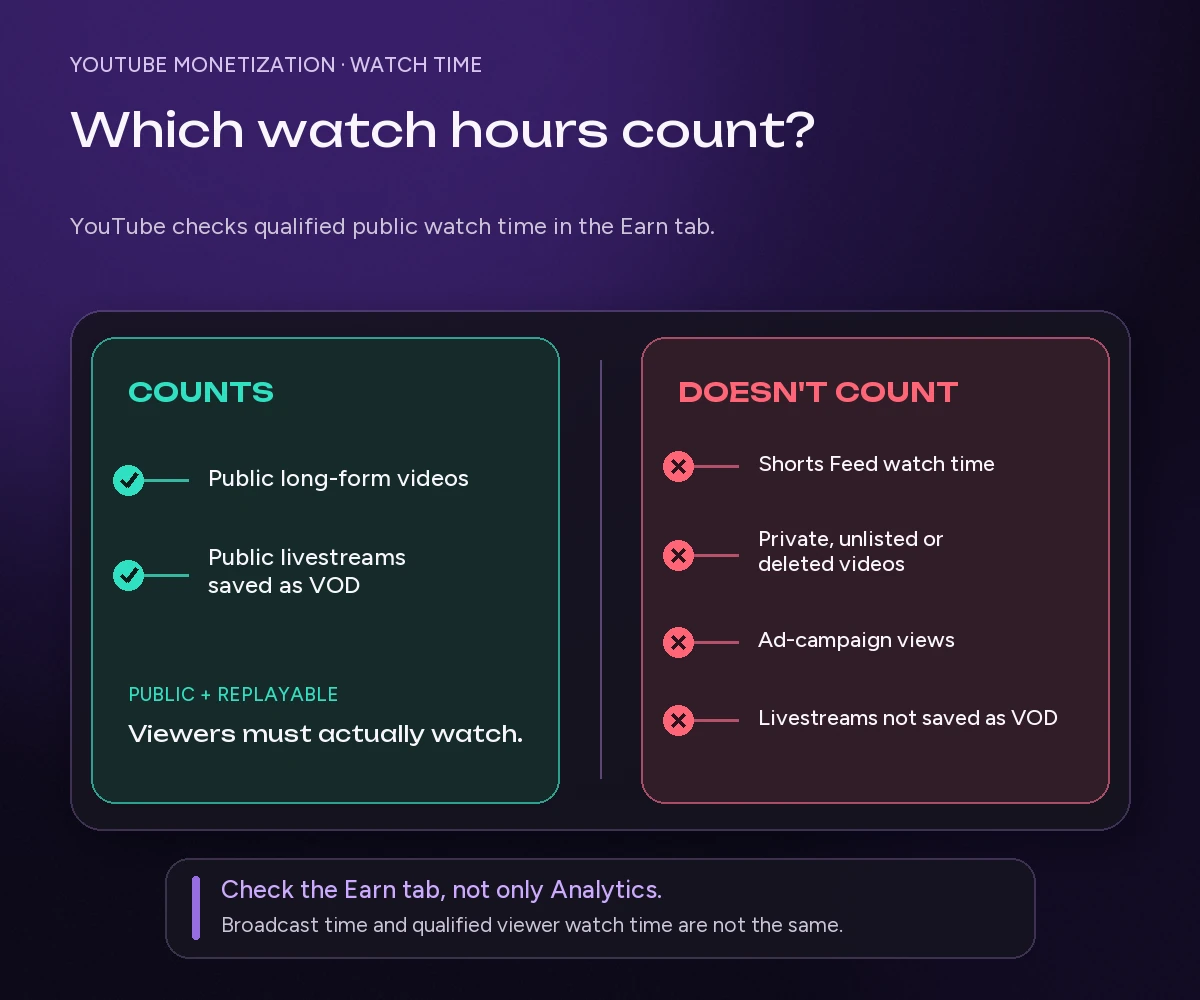
The relevant total is qualified watch time from public long-form content. Private, unlisted, deleted, and ad-campaign viewing does not count toward the threshold. Shorts Feed watch time does not contribute to the long-form hours route.
Live streams that are unlisted, deleted, or not converted to video on demand are also excluded. YouTube’s watch-hour definitions
Track the eligibility counter in Earn rather than assuming every hour displayed elsewhere in Analytics qualifies.
Watch hours measure viewers, not your upload schedule
A useful planning equation is:
Viewer watch hours = total minutes watched ÷ 60
For example, 60 viewers each watching 20 minutes produce 20 viewer-hours. A two-hour broadcast averaging 25 concurrent viewers produces approximately 50 viewer-hours.
Those are arithmetic examples, not forecasts or guarantees that every hour qualifies.
To put a larger target into practical terms, 8,000 hours is 480,000 minutes. At an average of ten minutes watched per view, that would require 48,000 qualifying views. At twenty minutes per view, it would require 24,000.
The lesson is not to make every video twice as long. It is to give the right audience a reason to keep watching.
Can live streaming help you build qualified watch time?
Live streaming can give viewers more time to watch and more reasons to return. Consider a weekly workshop, a community Q&A, a guided practice session, or a carefully programmed channel built around content you own.
However, leaving a stream running does not create watch hours by itself. You still need actual viewers, useful programming, and eligible public content.
For a channel working toward YPP, plan how broadcasts will become public replays. When comparing uploaded videos with streaming schedules, include the replay audience, not just the peak live audience.
Why the 12-hour archive limit matters
YouTube says streams shorter than 12 hours can be archived automatically, while longer streams may not be captured at all. It recommends keeping a local backup. YouTube’s archive guidance
A practical approach is to schedule distinct broadcasts comfortably below that limit, then verify that each replay exists and remains public. Do not assume stopping just before the limit guarantees successful archiving.
For example, a tutorial channel might run a themed workshop block, end the broadcast, check the replay, and schedule a different block later. The programming should make sense for viewers, not just for a counter.
Also distinguish your own backup recording from YouTube’s conversion of the live stream to VOD. Keeping a local file is sensible, but it does not prove that the original live watch time appears in Earn.
Where Upstream fits into a monetization plan
If you already have original lessons, demonstrations, interviews, or other useful videos, you can organize them into scheduled programming rather than leaving them as disconnected uploads.
Upstream’s prerecorded live streaming lets you upload finished videos, arrange the running order, and schedule playback from the cloud. You do not need to leave a local computer running to play that programmed stream.
One practical starting point:
- Choose a topic your audience repeatedly asks about.
- Select several related videos you own or can broadcast.
- Add a clear introduction and a logical running order.
- Schedule a broadcast with an archive plan.
- Review audience retention, replay availability, and Earn progress afterward.
Upstream handles delivery. It does not approve your YPP application, decide which hours qualify, or guarantee revenue.
A continuous channel may be a useful format, but an uninterrupted broadcast is not automatically the best approach for a creator who needs public archives. Start with programming you can evaluate and improve.
More watch time will not fix a content-policy problem
YouTube’s monetization policies require original, authentic content. They also address mass-produced or repetitive content and reused material. These rules apply to live streams as well as uploaded videos and Shorts. YouTube channel monetization policies
Owning a broadcast tool is not evidence of editorial value. Neither is changing a title or rearranging the same clips.
A stronger channel has a recognizable purpose, meaningful differences between programs, and a clear reason for viewers to return. If you use third-party material, review both your rights and the monetization rules. Permission to use something does not automatically establish that your channel meets every YPP requirement.
What should existing monetized creators check?
The entry increase is not the only announced change. From February 2027, Shorts Creator Pool earnings require 10 million qualified Shorts views over the preceding 90 days. Falling below that level does not remove a channel from YPP or affect its long-form earnings. This ongoing Shorts condition is different from the new Shorts entry threshold. YouTube’s announcement
YouTube also sets January 31, 2027 as the deadline to review and accept updated monetization terms. Its update includes separate activity requirements, so existing partners should read the full notice in Studio. Official YPP changes
If you are in the earlier-access tier but have not unlocked advertising, or an application is still pending at the transition, check your channel-specific guidance. The public pages reviewed do not fully resolve every transition case. Do not assume that reaching a number on the final day guarantees approval under the earlier rules.
Your next step
Check your Earn tab, identify your monetization route, and build a schedule around content people want to watch.
If you have a useful library ready, try Upstream to turn it into scheduled broadcasts. Start with one focused program, verify the replay, and improve from actual viewer responses.